What Security Guards Can and Cannot Do
- Published at
Security guards play an important role in keeping people, premises and property safe. You may see them working in offices, retail stores, construction sites, warehouses, residential buildings, hospitals and other private locations. Their presence can deter crime, help control access and provide reassurance when an incident occurs.
However, security guards are not police officers. This distinction matters because their legal powers are limited. While a trained guard can take sensible steps to prevent crime, protect people and manage a situation, they cannot simply do anything they believe is necessary.
Understanding what security guards can and cannot do helps anyone considering a security career, employing a security team, or dealing with a guard while visiting private premises. In most frontline roles, an operative will also need the correct SIA licence. Our guide to the Security Guard Licence explains the qualification and licensing route in more detail.
What security guards are responsible for
A security guard’s day-to-day responsibilities depend on the site and the employer’s instructions. The work may involve protecting a single building overnight, managing visitors at a business reception, monitoring a warehouse, patrolling a residential development or responding to an alarm.
In practical terms, security guards can help to prevent theft, vandalism, trespassing, disorderly behaviour and unauthorised access. They may check that doors, gates and restricted areas are secure, observe activity on site, report hazards and make sure visitors follow the site’s rules.
Guards are also expected to be alert, professional and calm under pressure. Good communication is often just as important as physical presence. A situation can frequently be resolved by explaining the rules clearly, speaking respectfully and requesting cooperation before it becomes more serious.
They may also be asked to keep written records. Accurate incident reports, visitor logs and handover notes help employers understand what happened and can be important if an issue later involves the police, insurers or a legal claim.
What security guards can do
Control access to private premises
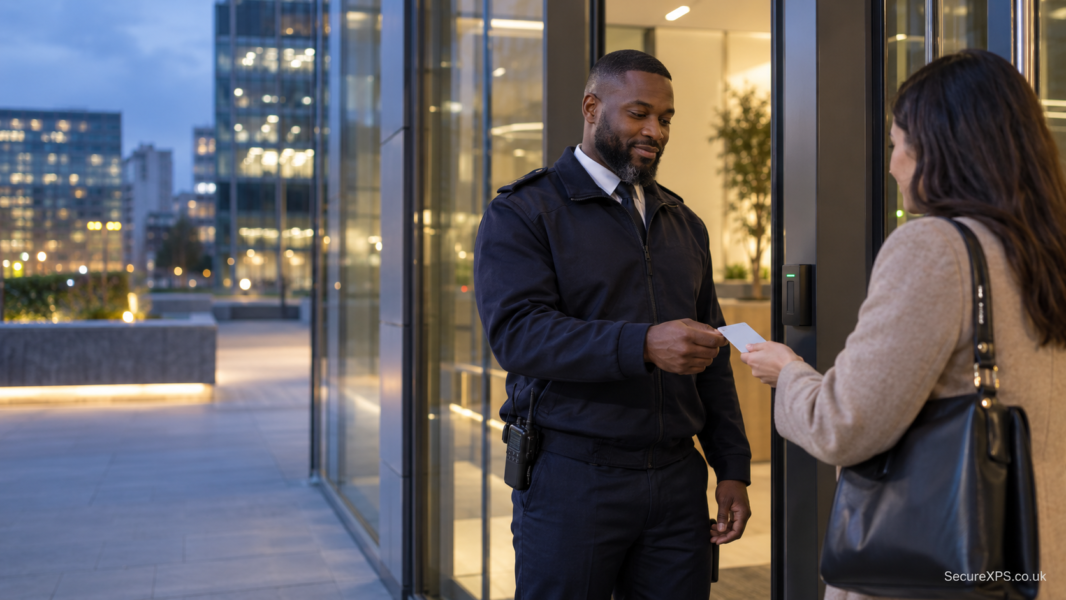
Security guards can control who enters a private site where the owner or occupier has given them that responsibility. For example, a guard may ask visitors to sign in, show identification, wear a visitor pass or confirm the person they are meeting.
They can refuse entry to someone who does not meet the site’s entry conditions. This may include a person without an appointment, someone who appears intoxicated, a visitor who will not follow safety instructions or somebody who has previously been banned from the premises.
The same principle applies to private events, offices, warehouses and residential buildings. Entry is not an automatic right simply because a building is open to the public at certain times. The owner or occupier can set reasonable access conditions, and security staff can help enforce them.
Ask someone to leave
A guard can ask a person to leave private property if they no longer have permission to be there. This could be because the person is causing disruption, refusing to follow site rules, attempting to enter a restricted area or remaining after being asked to leave.
If somebody refuses to leave, they may become a trespasser. The guard should normally remain calm, avoid provoking the situation and report the matter through the correct channels. Depending on the circumstances, this may mean contacting a supervisor, the site manager or the police.
A security guard should not use unnecessary force simply because someone is being difficult or verbally abusive. Professional communication and de-escalation should always come first.
Observe, monitor and report concerns
Security guards can patrol premises, monitor CCTV where this forms part of their role, watch for suspicious activity and report any concern promptly. They may identify risks such as an unsecured entrance, damaged fencing, an unattended bag, a fire-safety issue or an attempted theft.
They can also preserve important information by making detailed notes and, where appropriate, protecting the scene until the police or emergency services arrive. Guards are often among the first people to notice that something is wrong, so careful observation can make a major difference.
Security staff should report facts, not assumptions. A clear report should explain what was seen, heard or done, the time of the incident, the location and any action taken.
Use reasonable force in limited circumstances
Security guards do not have a general right to use force. However, like any other person, they may use force that is reasonable in the circumstances to prevent crime, protect themselves or others, or assist with a lawful arrest.
The key word is reasonable. The level of force must be necessary and proportionate to the risk at that moment. A guard cannot use force as punishment, revenge or simply to make somebody comply more quickly.
For example, if there is no immediate threat, physical intervention is unlikely to be justified. If a person poses an immediate risk of harming someone, the guard may need to act to protect people until police arrive. Every situation is different, which is why conflict management, personal safety and accurate reporting are essential parts of security training.
Carry out a search with consent
A guard may ask a person to agree to a search as a condition of entry to a private venue or workplace. This is common at some events, transport sites, retail locations and secure workplaces.
However, consent matters. A security guard cannot force someone to be searched merely because they are suspicious. If a visitor refuses, the usual response is to refuse entry or ask them to leave, rather than physically searching them.
Search procedures should be explained clearly and handled with dignity. Employers should also have proper site policies in place, including arrangements for searches of bags, vehicles and individuals.
What security guards cannot do
They cannot act as police officers
Security guards cannot pretend to be police officers or claim police powers that they do not have. They cannot issue criminal fines, demand personal information without a valid reason or carry out police-style investigations.
Their role is to protect the premises, manage risks and report concerns. If a serious crime, threat, or emergency occurs, contact the police and emergency services without delay.
This is why people entering the industry need to understand both their responsibilities and their limitations. If you are exploring this career path, read our guide on how to become a security guard in the UK, including the licence requirements.
They cannot force a search without lawful justification
A security guard can ask for consent to search someone, but they cannot normally force a person to be searched. If a person does not agree to a search, the guard may refuse them entry or ask them to leave private premises, depending on the site rules.
This is why many venues state their search policy at the entrance or in their terms of entry. The person has a choice: agree to the condition of entry or choose not to enter. The guard should explain the policy politely and avoid turning a refusal into an unnecessary confrontation.
Any search must also be conducted appropriately. It should follow the employer’s procedure, respect privacy and be carried out by a suitably trained member of staff. A security guard should never use a search as a reason to humiliate, intimidate or discriminate against someone.
They cannot use more force than is necessary
One of the clearest limits on a security guard’s actions is the use of force. Force may be lawful only when it is genuinely necessary and reasonable in the circumstances. It should always be the last option after considering communication, distance, observation, and de-escalation.
For example, a person refusing to leave but not threatening anyone does not automatically justify physical intervention. The guard should assess the risk, seek support and contact the police where needed.
A different response may be appropriate where there is an immediate risk of violence or serious harm. Even then, the aim is to protect people and control the risk, not to punish the individual. The amount of force used must be proportionate to what the guard reasonably believed was happening at the time.
They cannot detain someone without a lawful reason
Security guards do not have special powers of arrest simply because they work in security. In limited situations, a guard may be able to carry out a citizen’s arrest, but the legal conditions are strict and should not be treated as a routine security measure.
A citizen’s arrest may be possible in relation to certain serious offences where a person is caught committing an offence, or where there are reasonable grounds to suspect that they have done so. There must also be a genuine reason why it is not reasonably practicable for a police officer to make the arrest instead.
In a real incident, the safest approach is usually to contact the police as soon as possible, explain the facts and follow the employer’s incident procedure. A guard who wrongly detains someone could expose themselves and their employer to serious consequences.
This subject deserves its own detailed guidance. It should not be confused with a guard’s general ability to ask someone to leave private premises.
They cannot take property simply because they suspect theft
A security guard may ask a person to hand over an item voluntarily, particularly where a clear site policy applies, or there is an immediate safety concern. They may also preserve evidence and report the matter to the police.
However, a guard cannot take property from someone simply because they are suspicious or want to punish them. Any action must be justified, proportionate, and properly recorded.
Where theft is suspected, guards should avoid making unsupported accusations. They should observe carefully, follow the site’s procedure and involve the police where appropriate. Good evidence, accurate notes and professional behaviour are far more valuable than rushing into an allegation.
They cannot discriminate or treat people unfairly
Security guards must treat people fairly and professionally. A person should never be targeted, refused entry, searched or challenged because of their race, religion, disability, gender, age, sexual orientation or another protected characteristic.
There may be legitimate security reasons to challenge someone, such as entering through a restricted door, refusing to show a required pass, or behaving in a way that creates a clear safety risk. The decision must be based on behaviour, evidence and site policy — not assumption or prejudice.
Professional security work requires good judgement. Guards should be able to explain why they took action and show that it was reasonable in the circumstances.
Why training and an SIA licence matter
Security guarding is not just about standing at an entrance or walking around a building. It requires awareness, communication skills, conflict management, emergency procedures and an understanding of legal boundaries.
For many frontline security roles in the UK, you need an SIA Security Guard licence before you can legally work. The licence shows that you have completed the required training and passed the relevant checks for the role.
The right training helps guards recognise when to step in, when to step back and when to call for help. It also prepares them to write accurate reports, manage difficult behaviour professionally and protect themselves, colleagues and the public.
If you are considering this career path, SecureX Premium Services offers SIA training in London to help learners work towards their security career goals. You can also compare the responsibilities of different roles in our guide to Door Supervisor vs Security Guard.
Start Your Security Guard Career with SecureX Premium Services
Understanding what security guards can and cannot do is essential to working responsibly in the private security industry. A good guard protects people and property while staying within the law, following site procedures and treating everyone with respect.
To find out whether this is the right route for you, explore our Security Guard Licence course and requirements. SecureX Premium Services provides practical SIA training in London for people who want to build a professional future in security.